
The full build journal // games
Zombie Rush. From five nights to sixty.
I started with a little cure-crossbow game. With MakerMouse helping implement it and my family putting the builds through their paces, it turned into ten Outpost nights, fifty AEGIS operations, an Android APK and a browser release.
D4Maker · Built with MakerMouse · Started 29 October 2026
We didn't build AEGIS fifty nights in one go. We built it ten operations at a time, found new problems, changed the balance, rebuilt explosions, integrated music and then discovered the prettier artwork could break the aim. This is how I remember it, with the original checkpoints and recorded limits kept intact.
Choose a chapter below. Only one opens at a time, so you don't have to scroll through the entire manuscript to find a particular build stage.
The idea and the first ten nights
00Zombie Rush: the game that got bigger every time I thought it was finished
D4Maker · Development journal · Started 29 October 2026
I didn't set out to build a sixty-night campaign. I wanted something my kids could play: that old Storm the House 2 defend-the-base feeling, except the weapon was a cure crossbow, the zombies could turn back into people, and losing a night wasn't the end of the world. One simple browser game. That was the plan. I brought the idea and the decisions; MakerMouse, my AI development assistant, helped turn those decisions into code, test builds and fixes. My family became the people I wanted it to work for—and some of the most useful playtesters.
The first surviving five-night playable ZIP appeared about twenty-two minutes after the opening brief on 29 October 2026. That doesn't mean a game was magically finished in twenty-two minutes. It means we had enough working parts to open the browser, shoot a few zombies and start finding the problems. Once it played, the requests started writing themselves. What if we could reload while a giant was attacking? What if the fence actually bought us time? What if the rescued people came back to defend the new base? What if that nuke wasn't just a flash, but left a crater and smoke on a background that would still be there ten nights later?
By 8 November we had a public Cloudflare Pages build, a D4Maker website player, and Android APKs I'd tested on a phone. Along the way we built Outpost's ten nights, then AEGIS in five ten-operation blocks. We tested and changed the shop, crew, XP, enemy waves, armour, headshots, boss attacks, background art, soundtrack selection and mobile controls. When the mechanics finally felt good, we replaced much of the original Canvas artwork—and promptly found new ways to make things look wrong. A bat's legs went flat. A boss's shield bent with its walk cycle. Crew members fired at enemies their weapon barrels weren't pointing at.
This is the build story I actually want on D4Maker: the decisions I made, the fixes MakerMouse helped implement, the games my family tested, and the regressions that sent us back for another build. A list of release numbers cannot tell that story. There are original images and surviving source checkpoints to back many of those steps up. Where an image or measured number is missing, it's marked for review rather than invented.
The build wasn't a one-way march from alpha to release. I would play a batch, report what felt wrong, hand over another checkpoint, then play again. MakerMouse did much of the code and asset integration, but a green automated test could not tell us whether a boss was frustrating or whether the on-screen explosion was over the right hill. That's why my family's playtests and my own rough notes are part of the history, not a footnote.
What we ended up with: a playable 10-night Outpost campaign and 50 AEGIS operations; a browser release and Android builds; an offline-first save system with import/export; a collection of original Canvas art, hybrid artwork and audio assets; and a backlog that hasn't magically vanished just because the game is online.
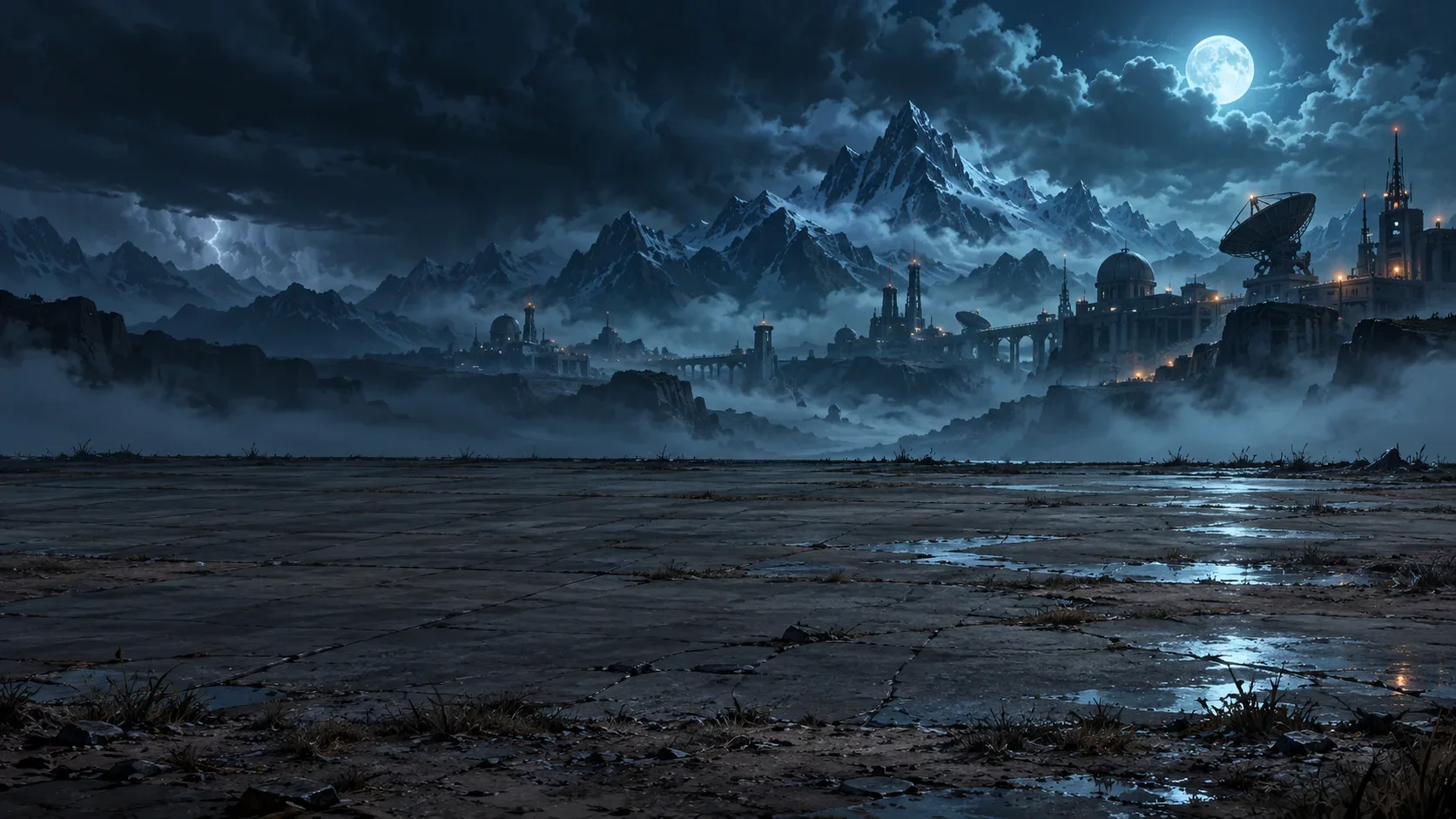
The later AEGIS battlefield, with moonlit mountains and the distant research facility.
Images still to add
0101 · An entire game drawn in a browser
My first brief to MakerMouse was deliberately small: I wanted to open an HTML file on my PC with no login or server, aim with a mouse, fire a crossbow, reload and defend a laboratory. The zombies weren't there to be blown apart. If you hit them enough times they were cured, turned into humans and ran away. The heavier bosses collapsed and faded instead. We could still have ridiculous green mist, cure barrels and a giant shower. I wasn't trying to make a medical simulator.
MakerMouse helped build the first playable version in plain HTML, CSS and JavaScript, with the browser's Canvas 2D drawing surface. I could open the result, play it and report what didn't feel right. The original source split combat rules from rendering. That mattered later. The engine could decide whether a shot hit a head, how much money a cure earned, whether a reload finished, and whether the base had actually lost. The renderer could draw a zombie in a torn blue shirt without needing to know how the money system worked. The basic world was 1280 × 680 logical pixels, scaled to the browser; pixel density was capped so high-resolution screens didn't create runaway rendering cost.
The art came first as code, not as a pile of sprites. The laboratory was rectangles and sandbags, with a glowing window; the enemy's body came from a handful of simple shapes; the first crossbow had limbs, string and stock drawn directly in Canvas. There was a shambler, a runner, a brute and a bat, then Count Vesper as the five-night boss. Early movement was deliberately crude—legs oscillated, bats flapped their wing tips, and civilians swung their feet as they ran. I wanted something moving and shooting that I could judge with my own eyes, not another beautiful concept that hadn't survived a real round.
There were two visible difficulties. Classic was meant to fight back, while Junior softened speed, health and damage and allowed assisted held firing. The first version also introduced a small upgrade shop, recruited helpers, a single-charge All Mighty Shower, barrels that exploded in an area, pause, restart, and a checkpoint format that could be exported to JSON. We gave the player the familiar controls—click to fire, R to reload, P or Esc to pause, Space for the emergency power—and made the touch buttons large enough to find. That was implementation, not proof that the layout would feel good on a real phone.
The very first test wasn't 'does it look cool?' It was 'can the rules hold together?' The archived v0.1.0 test report lists 13 engine checks: shooting, ammunition, reloads, money, barrel detonation, the shower's five-second charge, retry rollback, saved checkpoints, helper attacks and an actual possible loss. A seeded automated player cleared all five nights in both modes. We recorded the limitation clearly: a bot with excellent aim says the campaign can finish, not that my kids would find it balanced. A desktop Chrome smoke test checked that the menu and battlefield rendered, saved progress resumed and buttons responded. There was no claim of physical phone testing at that stage.
That first build still mattered. All the later drama—the boss tuning, the money economy, the AEGIS architecture, even the mobile nightmares—grew from these few working rules. Without a playable first night, we'd just have been arguing about how a zombie ought to look.
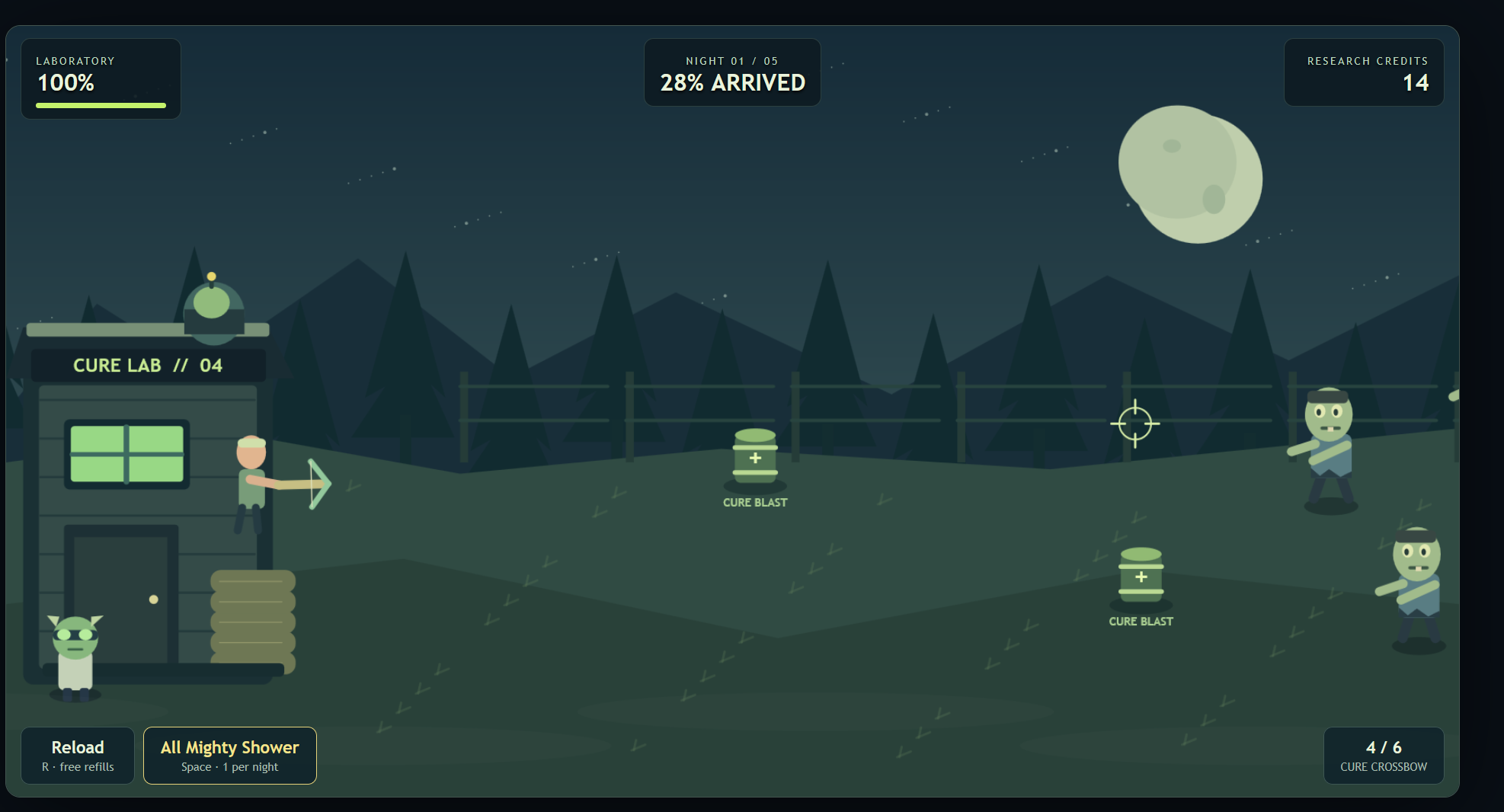
The original code-drawn lab and zombies, with cure barrels already in the battlefield.
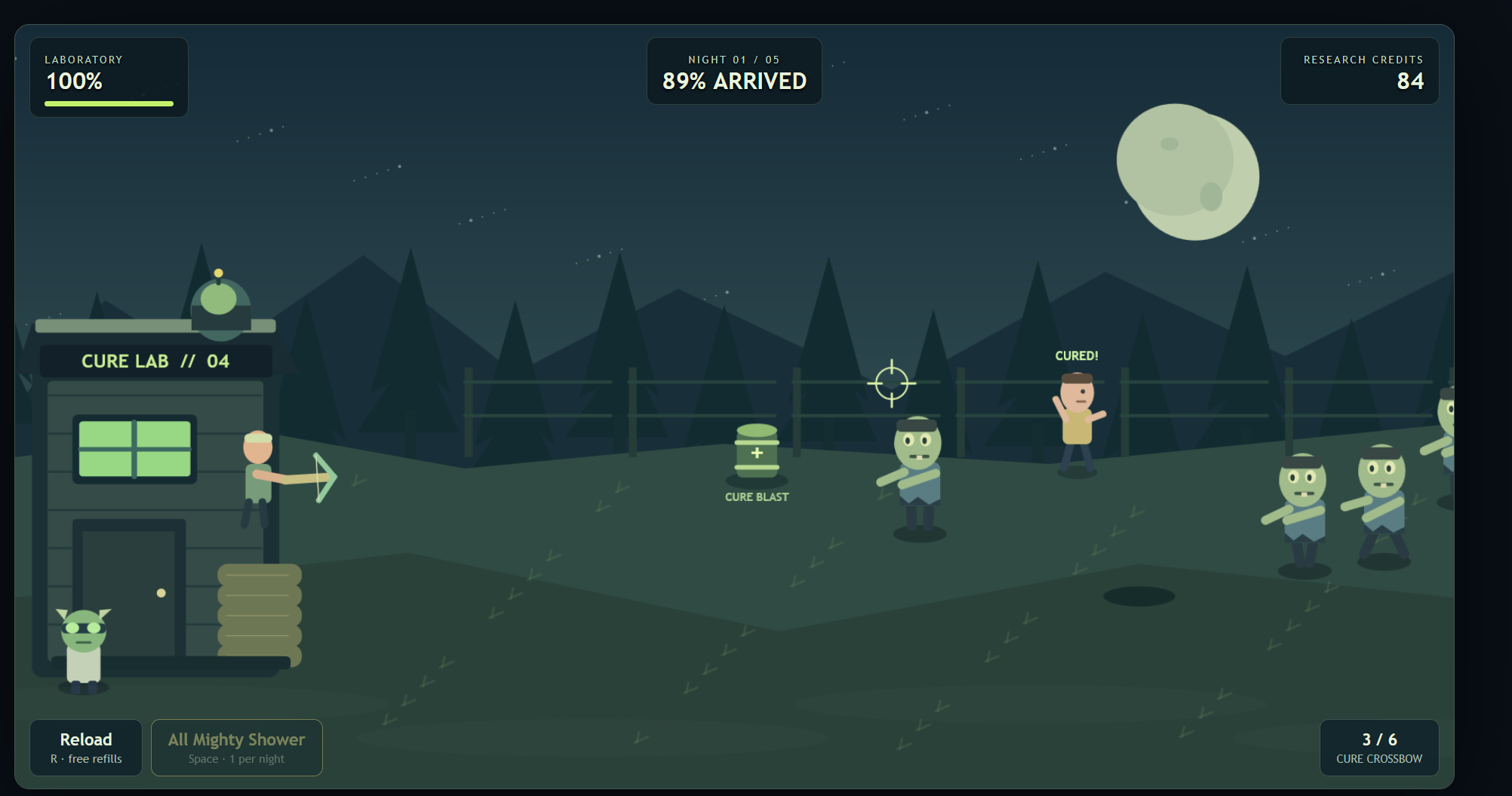
A cured human celebrates while the remaining zombies continue towards the lab.
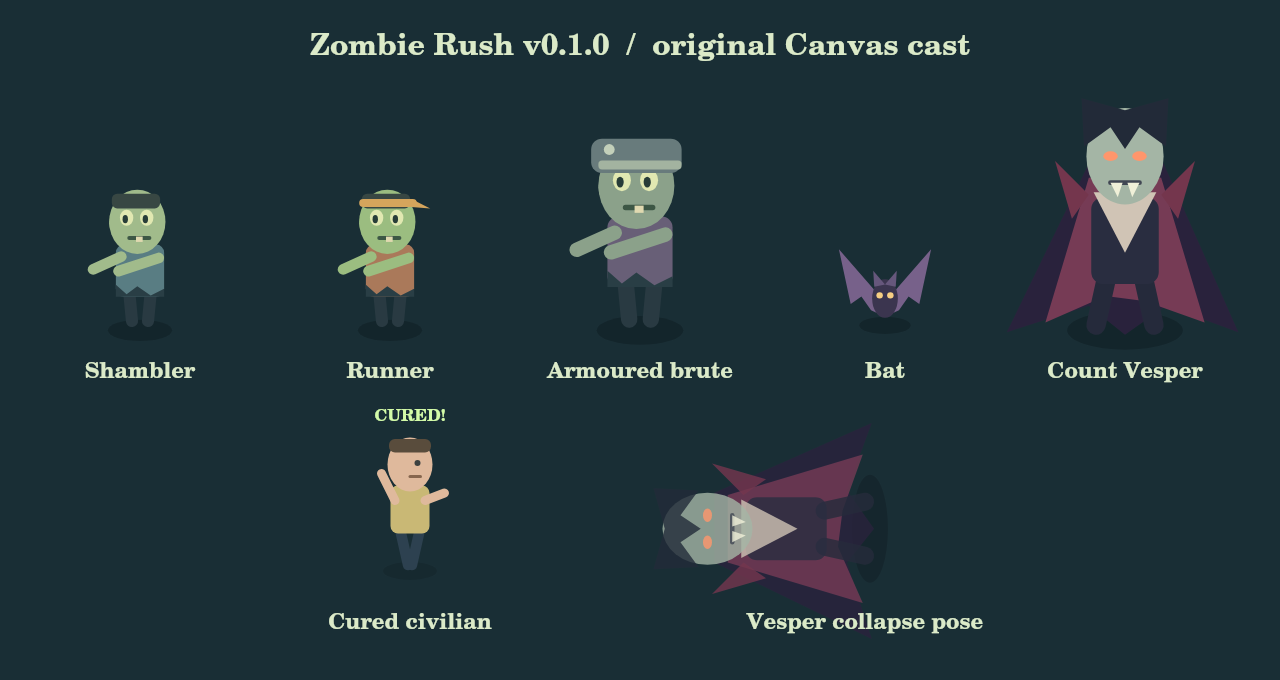
Early shambler, runner, brute, bat, Count Vesper and a rescued civilian.
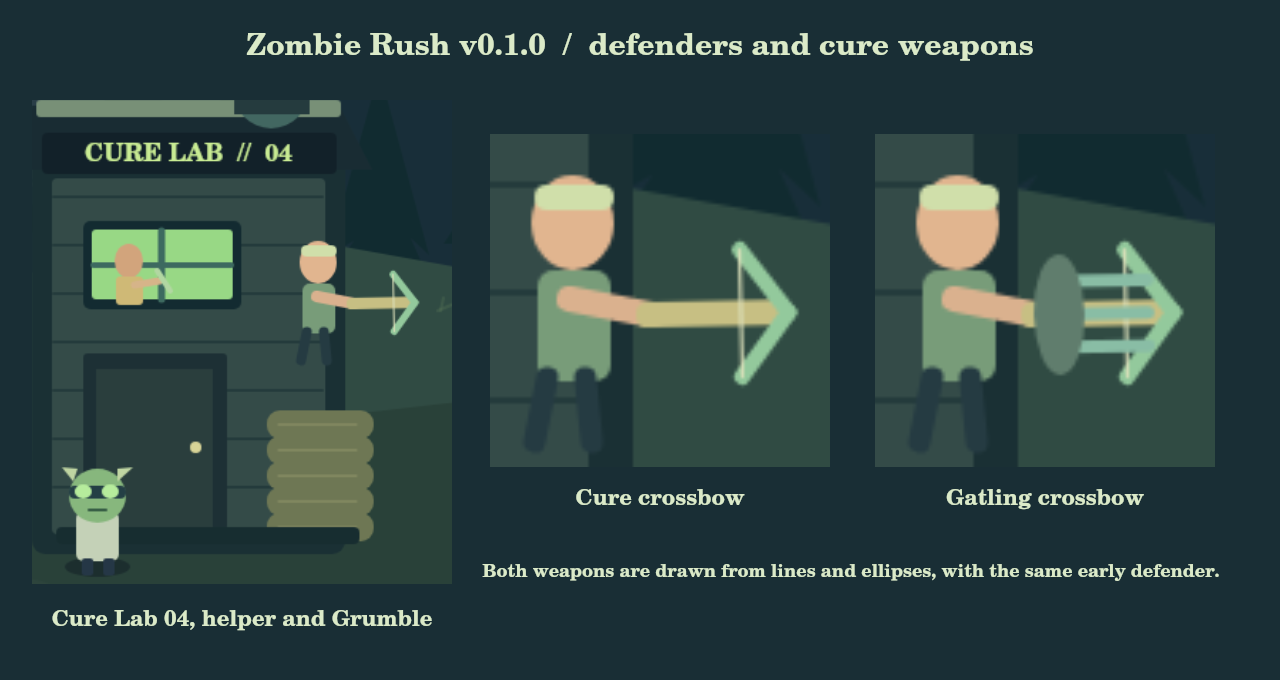
The code-drawn starter and Gatling crossbows next to the first laboratory.
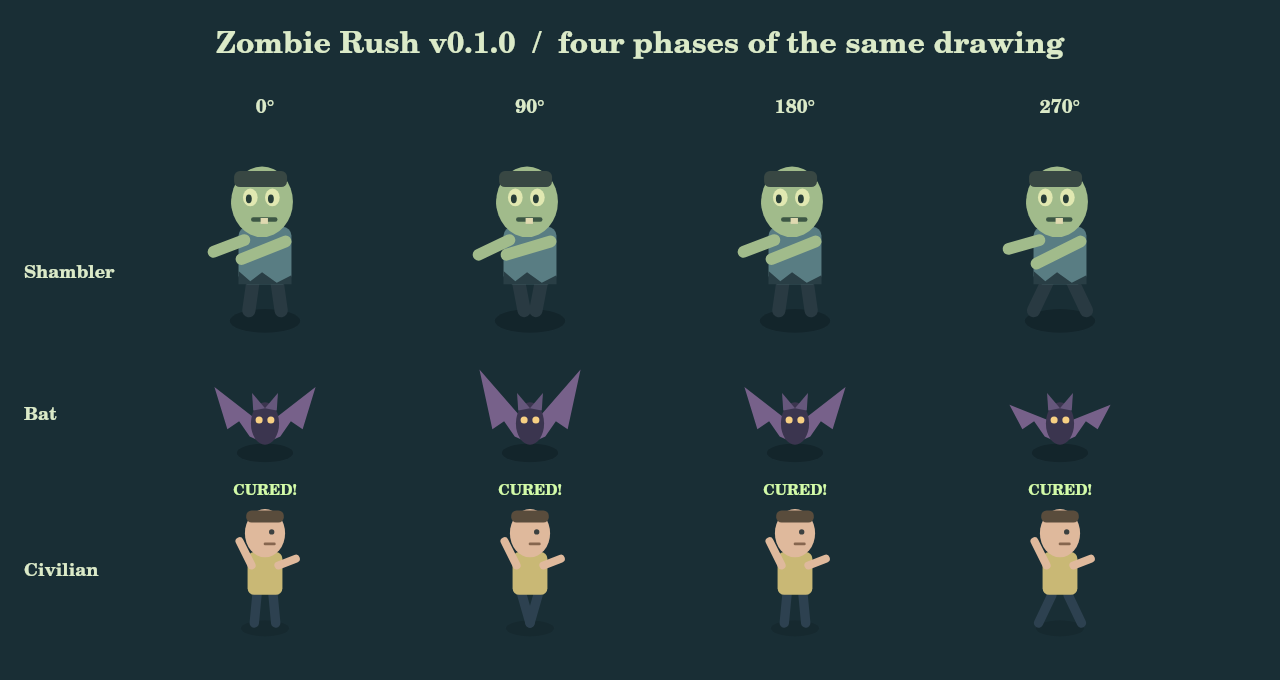
An early motion study with procedural zombie, bat and civilian movement.
Images still to add
0202 · Five nights became ten, and the old shop stopped fitting
The first five-night alpha was a slice, not a campaign. We could reach Vesper, spend some credits and see the cure gimmick working, but we could also see the seams. The drawings were readable without being much of a world. A six-card shop was fine until every new idea demanded another card. The boss didn't yet feel like a proper end-of-chapter threat. I wanted more reasons to choose where the money went.
Nightfall v0.2.0 put a painted moonlit woodland behind the code-drawn characters. That is a useful distinction in the history: the scenery became illustrated before the people did. We kept the vector zombies and weapons, but suddenly they had somewhere to stand. The lab gained expansion and armour options; the shop moved into tabs; the Gatling became harder to buy early; bat silhouettes grew; precision head hits became more noticeable; and Big Gus got a grounded approach with a stream that could be aimed instead of appearing as a detached effect. The sound changed too, with Kenney CC0 foley added to the original browser-generated cues. The v0.2 notes recorded 17 engine tests and actual decoding of 13 sound clips, while still calling for human balance and device tests.
My own playtest was the useful part. I finished v0.2 on the second attempt, as recorded in the checkpoint. That made me want to keep pushing the idea; it certainly didn't mean the balance was solved. The next batch was v0.3.0: ten Outpost nights. We added another boss, the Hollow Rider, plus jacklings and wraiths, broader weapon choices, an electric fence, crew assignment and training. One of my most practical requests was to keep ordinary firing available during Gus's five-second stream. It would have been easy to make the special look spectacular and inadvertently disable the crossbow for half the fight.
This is when the shop started becoming a game of its own. Weapon upgrades had to be shown clearly; a spare crossbow should be assignable to a defender rather than disappearing into inventory; armour, repairs and fences had to be worth buying without making the lab immortal. I kept asking what the upgrades actually did, because the numbers on a card were not always the numbers a shot used. Later we had to show the stacked effects—formula strength, capacity, reload rate and crew-specific improvements—instead of leaving players to guess.
The ten-night Outpost finally gave us enough story to leave it behind. We weren't just going to add level eleven on the same road forever. We would evacuate, blow the place behind us and reach AEGIS. That decision changed the shape of the entire project.
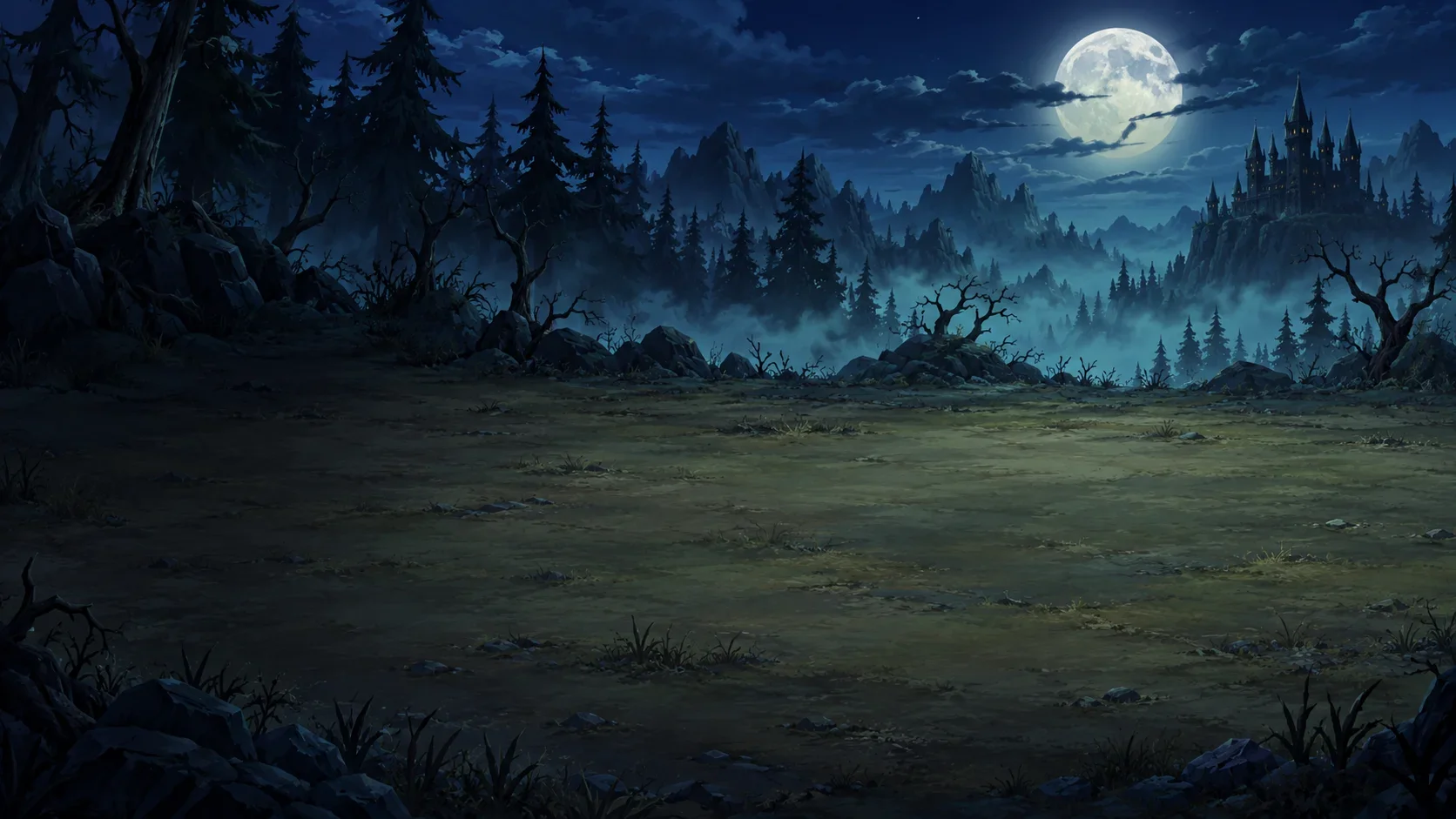
The moonlit woodland backdrop used behind the Outpost combat.
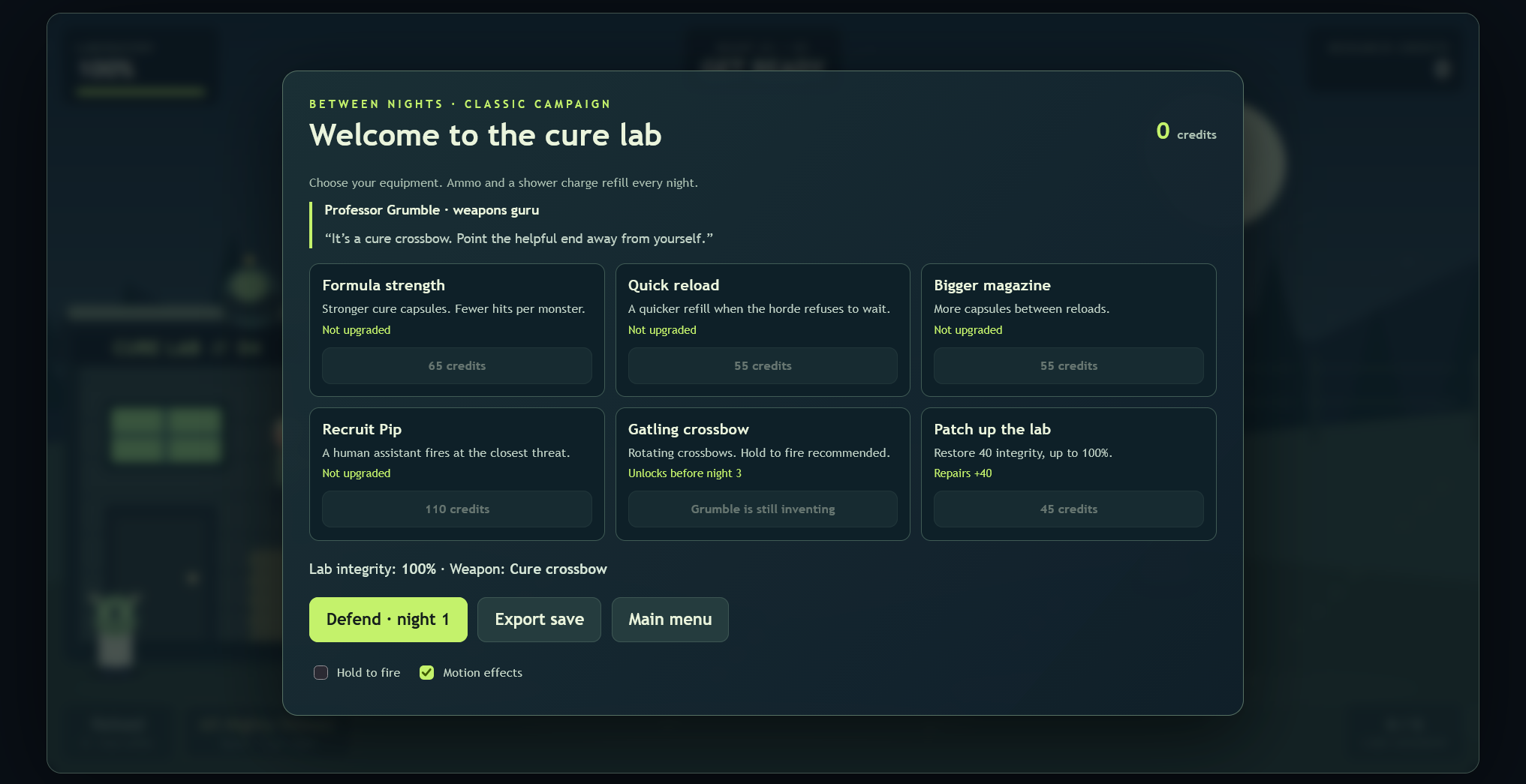
The original upgrade shop and its save export option.
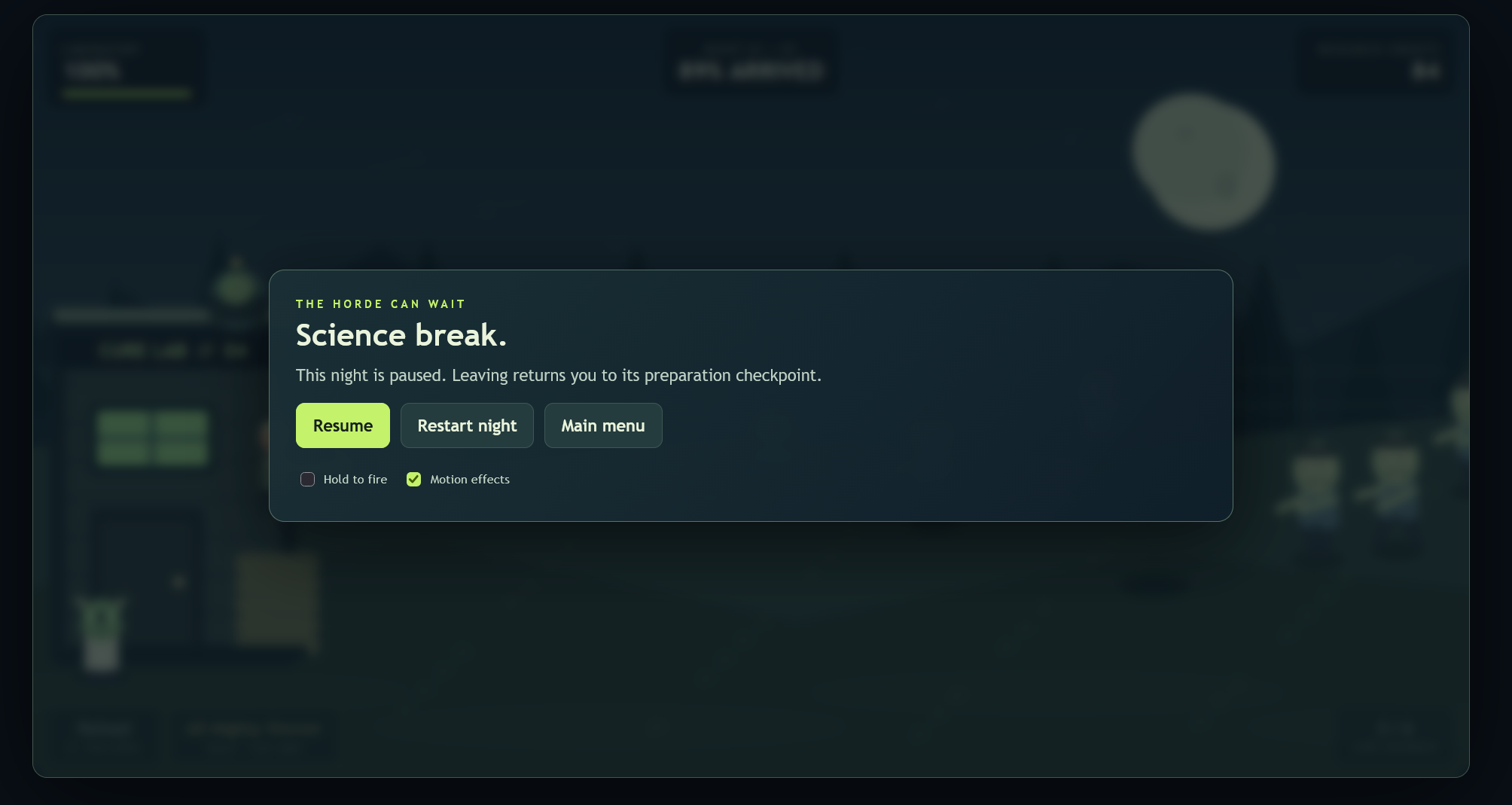
An early pause screen with resume, restart and menu actions.
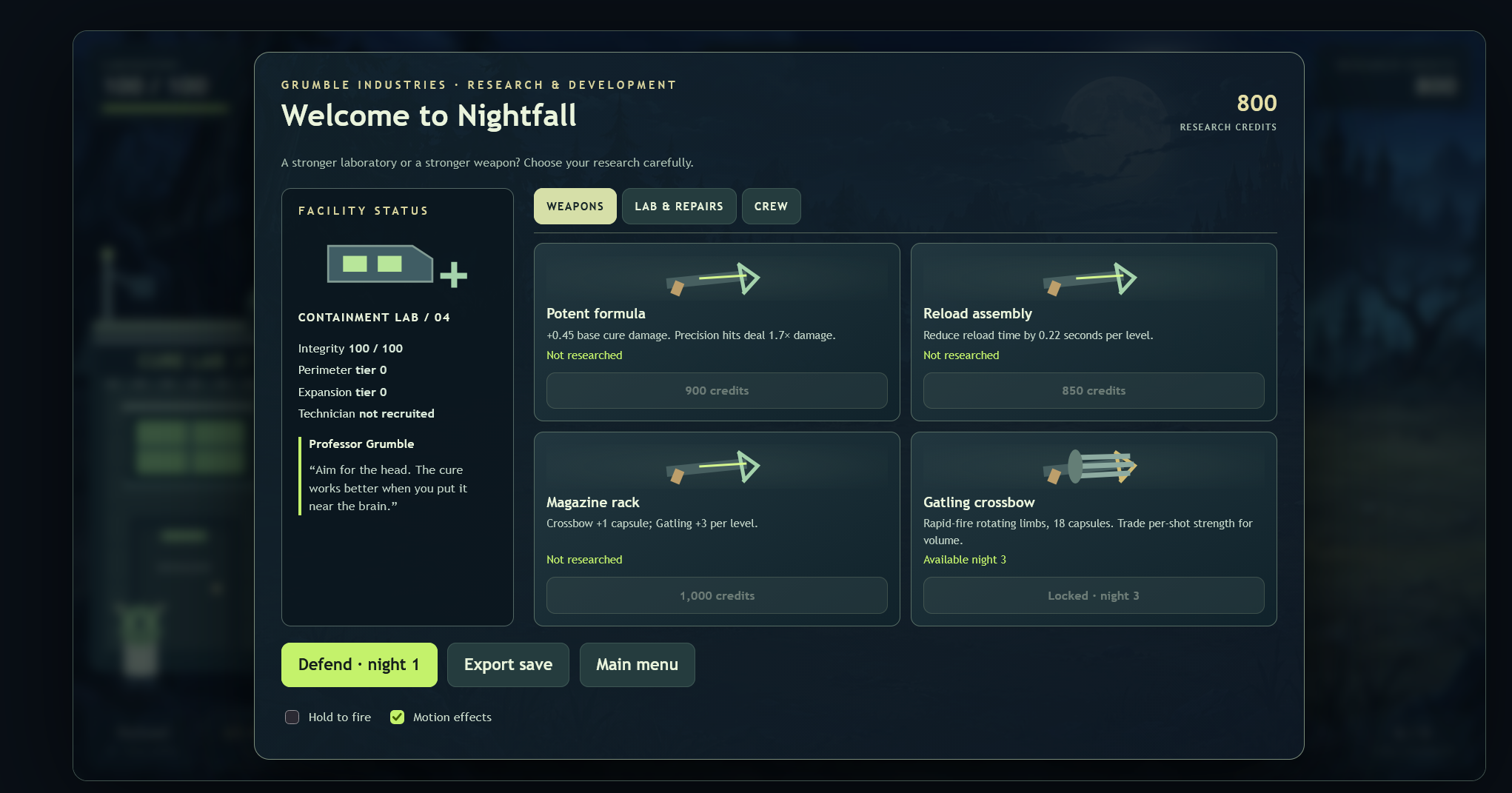
The Nightfall Weapons tab brought illustrated weapon upgrades into the workbench.
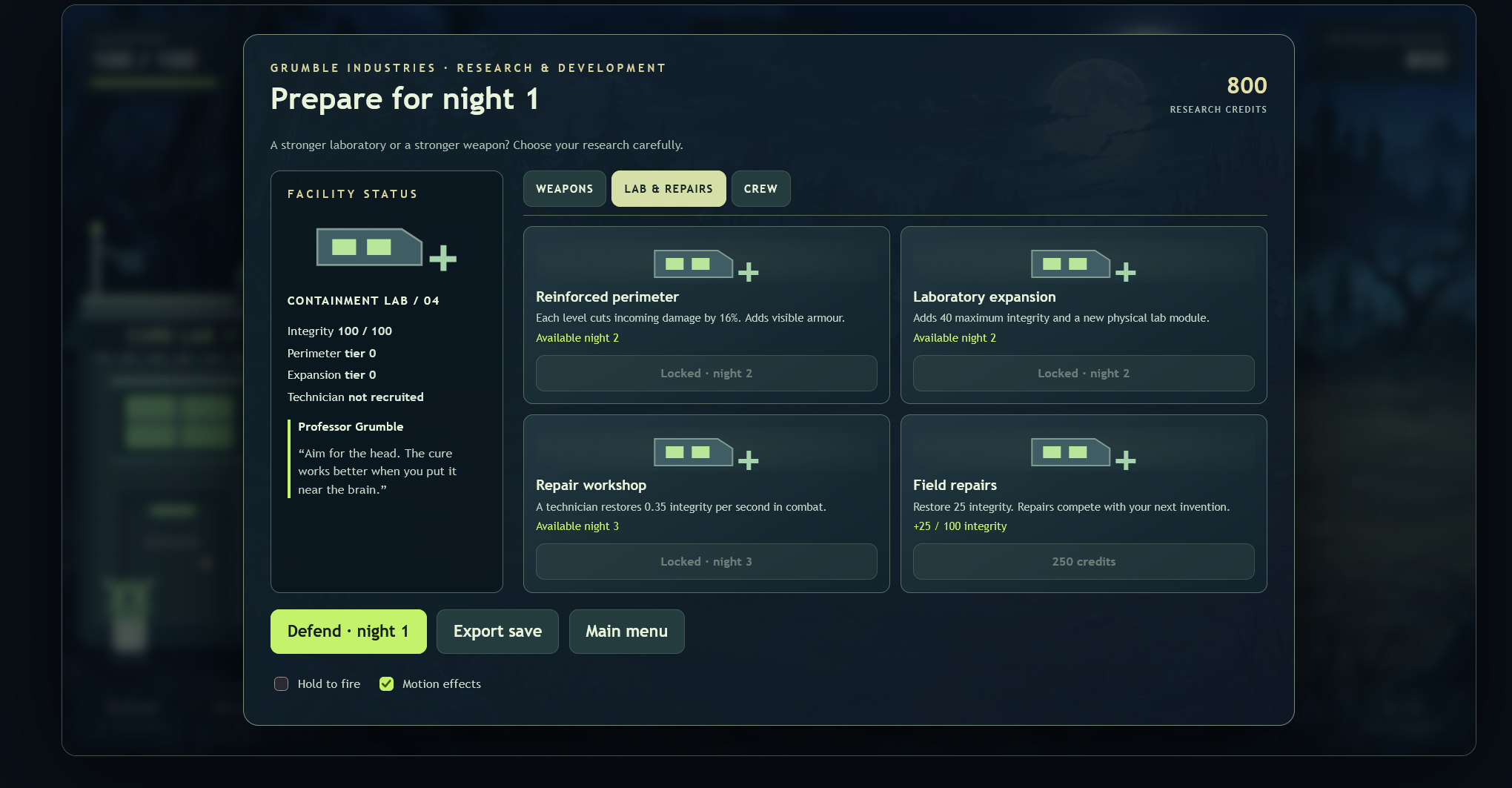
The Nightfall Lab and Repairs tab for perimeter equipment, repairs and facilities.
Images still to add
AEGIS: ten operations at a time
0303 · AEGIS, part one: build ten operations, then find out what breaks
I didn't want AEGIS to be a fancy name slapped over the same Outpost. The transition needed a new base, a reason to be there and rules for what carried across. The Outpost had a convoy, a cure capsule and a shockwave: a send-off with an actual consequence rather than a line of text that said 'new map unlocked'. The new laboratory was larger, more industrial and eventually had space for roof nests, side pods, reserve cannons and scientists. It still needed to be legible while zombies tried to eat the wall.
The early AEGIS work appears in the v0.4.0 transition checkpoints and v0.4.1 polished playtest, recorded on 30 October. Together with Outpost, that archive describes twenty playable operations—the first ten AEGIS operations followed the first ten Outpost nights. I didn't ask MakerMouse to build fifty AEGIS waves in one giant pass. We worked in groups of ten and stopped to test what we had. We built enough campaign to cross the transition, exercised that new part, recorded the problems, and then added the next block.
One problem was what happens to people you bothered to save. Equipment and upgrades initially reset on arriving at the new base. That gave AEGIS a clean progression curve but made the evacuation feel slightly pointless. Later we added a way for a returning crew to retrain and rejoin from AEGIS operation three. That isn't just a story tweak: it has implications for inventory, XP, save migration and which helpers are eligible to shoot.
I also wanted the presentation to evolve with the campaign. v0.4.1 redrew humans, zombies and the new base in Canvas and rebuilt the title, workbench, crew, briefing, journal and debrief screens. These weren't all cosmetic. A crew screen that makes it hard to allocate a spare weapon is a progression bug. A shop that shows old stats after an upgrade is a trust problem. A large new location that isn't represented by the backdrop or extensions doesn't feel like a new base.
Early AEGIS testing was a mixture of checks that could be automated and things that needed a person. Native Canvas fixtures showed the new base and character drawings. Progression checks could prove that a wave reached its exit, a save resumed, and a later operation was accessible. None of that proved the new controls felt good or that the player could read a boss through an explosion cloud. My next playtest observations fed straight back into another patch.
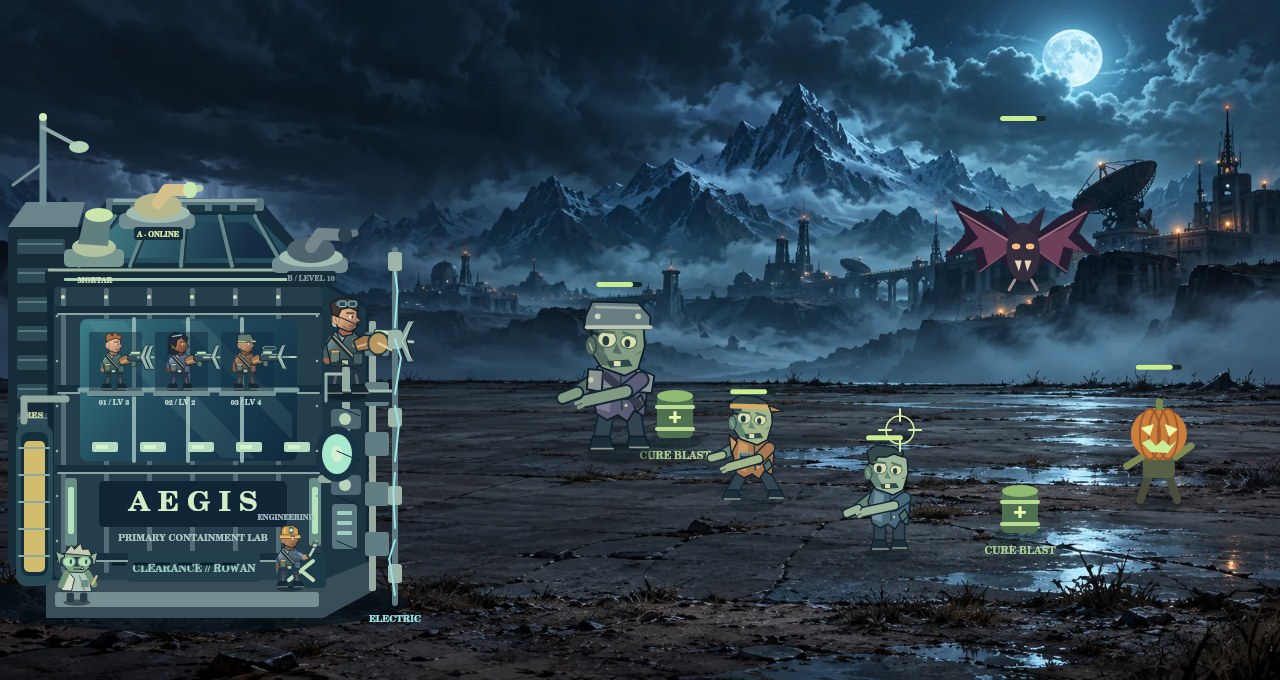
A code-drawn AEGIS laboratory and original characters against the mountain scenery.
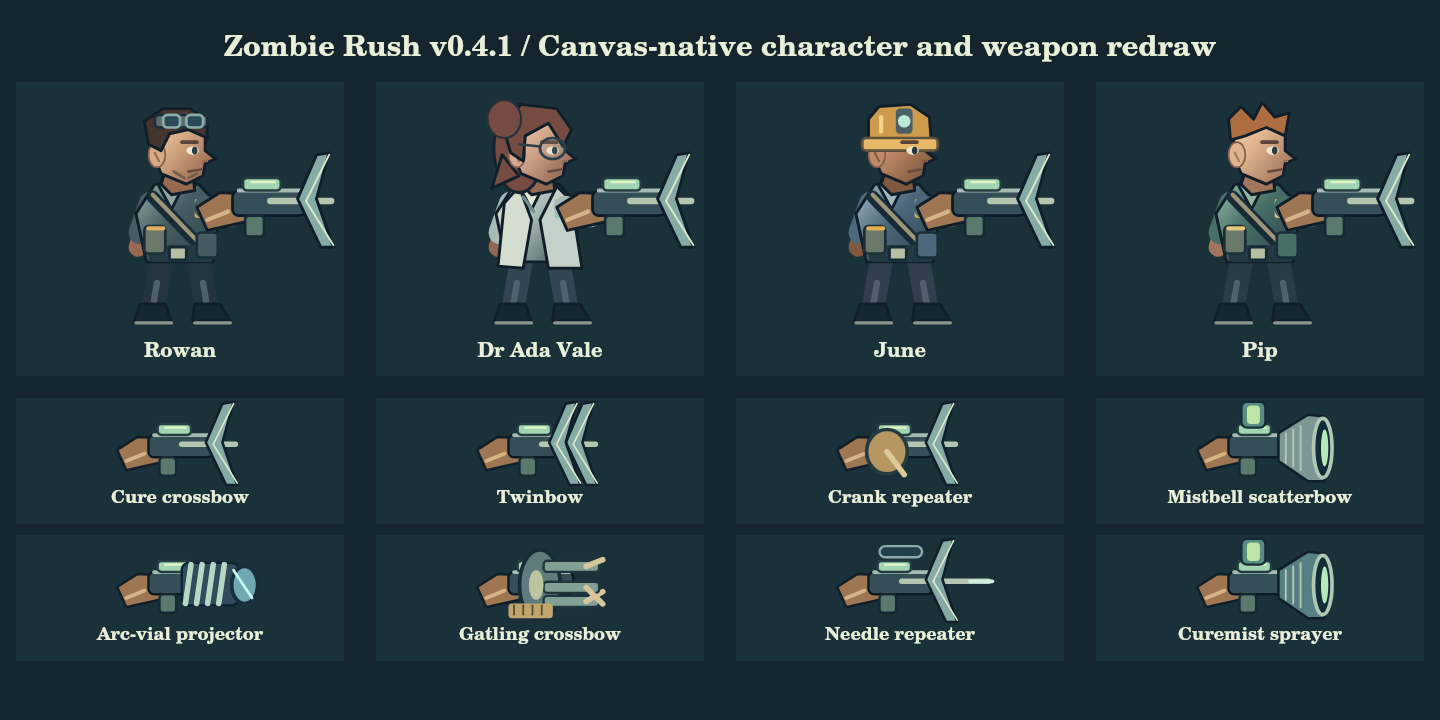
The redrawn crew and code-drawn weapon sheet used as the game moved beyond the first Outpost.
Images still to add
0404 · AEGIS, part two: money, crews, and the next ten nights
Once AEGIS existed, I wanted a reason to fight for it beyond another wave counter. By the second block of AEGIS operations, the economy was no longer just 'shoot zombie, buy bigger bow'. There were helpers who could level up, a repairer, spare weapons, research tiers, lab repair, bank interest and more than one defensive system competing for the same money.
The first feedback patch v0.4.2 sounds modest until you look at the list. Research cards were changed to show cumulative formula, reload, capacity, armour and repair effects. Crew members could finally receive eligible spare purchased weapons directly from the crew screen. The Mistbell was rebuilt as an actual three-bolt scatter weapon, with projectiles separated by −20, 0 and +20 vertical offsets, one shell per trigger, and a small visible splash circle on impact. Bats had a precision area moved onto their visible faces, with the floating shadow removed. These weren't random 'add a feature' requests. I was playing the game, noticing where a rule and its display disagreed, and asking MakerMouse to repair both.
Then came the v0.4.4 economy and crew pass, followed by v0.5.0 AEGIS Act II. The next ten operations added new pressure and boss progression. We were also dealing with interest receipts and the consequences of keeping crew between locations. A 10% bank-interest mechanic sounds easy until the on-screen receipt is confusing: players need to know how much was earned fighting, how much was interest, and why the new balance changed. Otherwise it's hard to tell whether a successful strategy was the shooting or simply leaving money in the bank.
This was also the period where game audio was being rebuilt rather than left as a handful of clicks. I've given that work its own chapter because it ran alongside the progression fixes. Looking at a release title alone, you would never guess how many separate systems we were touching.
A typical feedback cycle was unglamorous: I would open a save, buy the upgrade, inspect the card, play a wave, then check the debrief. If the helper used the wrong weapon or the bank receipt didn't add up, we had to trace the mismatch through both the game rules and the UI before calling it fixed.
The useful test for this block wasn't merely 'operation twenty is reachable'. It was whether upgrades held their promises through a campaign save, whether a helper really used their allocated weapon, and whether failed nights restored the correct starting money, purchases and charges. Every persistent system becomes harder to change once a player has a save they care about.
Images still to add
0505 · AEGIS, part three: Supply Line and the world outside the lab
I wanted a campaign, not just a counter going up. We'd already defended one outpost, fled to AEGIS and seen that a new base needed its own upgrades. The v0.6.0 Supply Line block took AEGIS into the twenties and started telling us what was happening beyond the walls. Distant strongholds existed. People were trying to hold them. They could fail, even if our own lab survived the night.
I didn't want every new operation to be the same zombie pile with another ten percent health. We started mixing the threat types deliberately: ordinary zombies, fast runners, bats, wolves, cockroaches, ranged spitters and the more complicated enemies that arrived later. Shooters, in particular, changed the meaning of a defence line. They could stand off and charge a hit instead of walking obediently into the crossbow. They had to look different on screen; recycling a wolf silhouette for a ranged enemy was confusing, and we eventually asked for a properly humanoid shooter.
The war outside also had to show up in the background. By AEGIS 26, the bridge/viaduct was demolished. The event wasn't supposed to destroy our own lab or silently charge the player resources. It was a story beat we could see and hear, while the normal operation still had to continue. That turned out to be much harder than adding a caption saying 'the bridge is gone'. The backdrop needed an actual damaged version, and later missions had to keep showing the damage rather than slipping back to a pristine landscape.
From a testing point of view, this raised questions that didn't exist in the first alpha. Did the event happen at the right point in the operation? Did pausing stop the cinematic's clock? Did retrying play the event again? Could the frame change underneath the action without making it look as if the shockwave hit the lab? Was there still a viable path to win without depending on an enormous reserve tank? I didn't want a cinematic to manufacture a loss or make our balance checks meaningless.
This is the sort of work that disappears in a short article. It shows up as one moment in the finished game and may take several rounds of background edits, timing changes and fresh runs before it stops looking wrong.
Images still to add
0606 · AEGIS, part four: the Reanimator, the rushes and another strike
AEGIS 31–40 was built and released as the v0.7.0 Last Strongholds block. This time the wave script was much more deliberate than 'add ten percent more enemies'. The block introduced the Reanimator, staged paired and triple Spitter fire, armoured columns, precision weak points, rushes at operations 34 and 38, rescue corridors and bosses that could call support. Operation 40 was the Null Archon and a cliffhanger about sending the global cure.
The Reanimator was particularly awkward because she breaks the usual rule that curing an enemy makes the battlefield safer. She could find a cured human running home, tether them and bring them back as an attacker. But the implementation had to be fair. She was supposed to operate from the rear, have a visible curse you could interrupt, and stop awarding repeat money or XP when a previously cured enemy was recycled. Otherwise a player could farm the same zombie indefinitely. The release rules capped live reanimated attackers at six and prevented repeated rewards using the original source identity. The later balance pass gave her a short ward and a purple protection aura, which meant we also had to make that protection readable rather than a mysterious loss of damage.
This act made me realise the economy, music and difficulty were now part of the same decision. A rush was not just a 'scary' label. The enemy speed boost needed to be real and applied only once. The campaign metadata had to identify the special operation, so the game could show an appropriate warning and pick the appropriate music group. The v0.7.0 rules used one additional ten-percentage-point speed boost for rush operations, on top of the normal additive AEGIS scaling. A careless second multiplier would have made the late waves quite different from what was planned.
The second containment strike moved to operation 31, damaging Bridgewatch while the previous Bracken smoke and fire continued on the distant skyline. I wanted to see the world getting worse—not watch yesterday's burning stronghold magically repair itself. Like the bridge, the effect needed a suitable damage plate, an origin anchored to the correct spot and timing that didn't cost the player their own base. The story still had to make sense if the player paused, lost the night or loaded a checkpoint.
We tuned support research at the same time. Roof turrets, the close-defence flush and the mortar each had five paid tiers; useful damage earned research XP before the purchase. The rules explicitly excluded reanimated units from earning extra research XP. Mortar blasts had a lingering field for one second, with the strongest overlapping field used rather than unlimited stacking. I wasn't trying to turn the game into a spreadsheet. I wanted to trust that the things I bought actually behaved as described.
And we didn't treat 'playable' as 'perfect'. At various points the Classic campaign still felt too easy, then one version made a boss dangerous enough to stop progress. AEGIS 31–40 was a released chapter with documented checks, not the final balance answer.
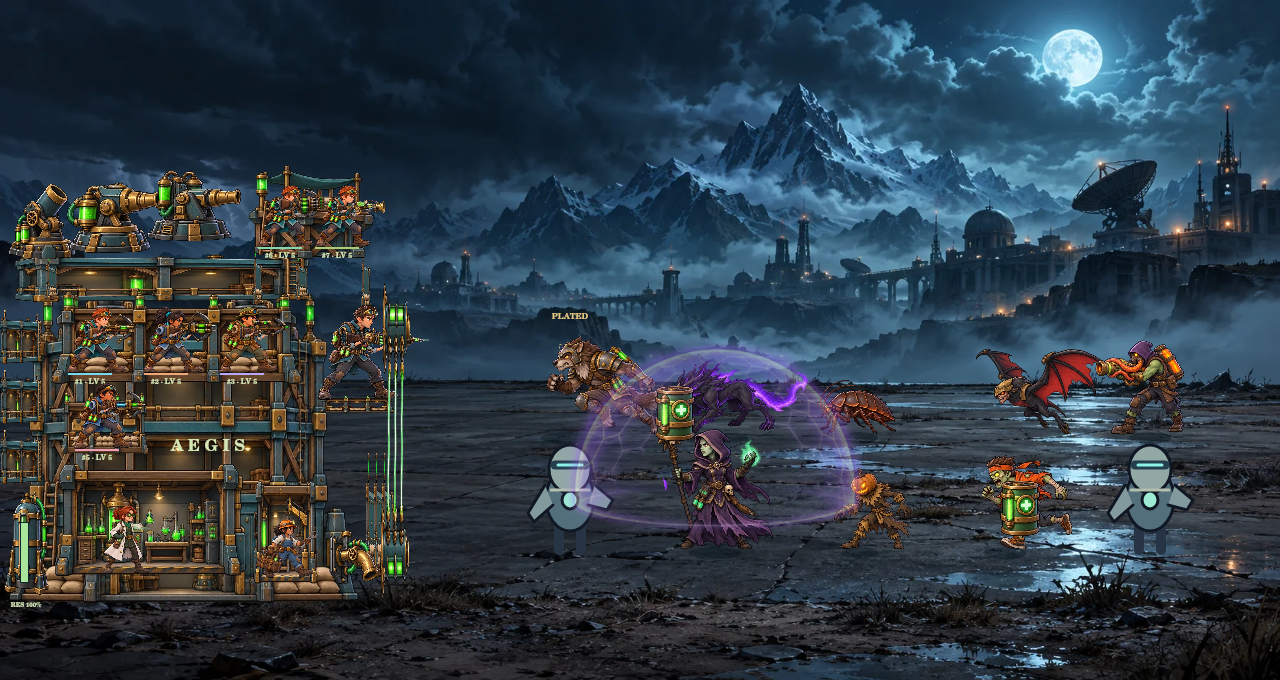
Illustrated AEGIS with flying threats and a purple shield in the artwork preview; not an operation-specific gameplay capture.
Images still to add
0707 · AEGIS, part five: Above the Ash and the ending we nearly lost track of
The fifth AEGIS block, 41–50, completed the promised sixty-night structure: ten at Outpost and fifty at AEGIS. The v0.8.0 Above the Ash release reached a saved boundary after AEGIS 50, and finally delivered the global cure. I could have asked for ten more waves and called the campaign done. Instead we had a proper final act to build and test, including an armoured uplink corridor, a cockroach swarm, a rush of hunting packs, a guardian, a cured-runner rescue, a launch gantry siege, a final rush and the Last Vector encounter.
The previous background changes had consequences here. Operation 40 left the observatory destroyed and the atmosphere full of orange ash; operation 41 was supposed to inherit that world, not restore the original moonlit skyline. We generated three new background plates in sequence: first the broken viaduct, then the fallen watchtower with the viaduct still broken, then the destroyed observatory and ashfall. I kept pushing for the same place to survive from one background to the next, scars and all. Otherwise the campaign looked like a slideshow of unrelated paintings.
The facility also changed as you invested in it. Garrison upgrades added a fourth firing bay, then a single-seat crow's nest, then a wider position for two shooters. Lab expansion created three side pods. Two reserve cannons needed to remain visible and unobstructed after the building changed shape. The scientist animation cycled between working with a flask, stirring and inspecting a vial. Those details mattered to me. AEGIS needed to look as if people were genuinely trying to make a cure, not standing behind a decorative wall.
The final boss was meant to ask whether we'd learned how to use counters rather than simply bought every upgrade. The Last Vector had armour and electricity was useful against it. Its later fight design included deliberately slower movement, charge-up laser attacks at stops, support calls and a weaker, fast close-range attack once it reached the fence. Stun and emergency-behaviour ideas needed their own encounter testing; not every proposal should be described as verified merely because it was discussed.
And then there was the ending. We wanted an evacuation and cure launch that felt urgent, with the characters still the correct size and in the correct positions between shots. In earlier art checks I'd found Gus looking absurdly huge and Rowan appearing in the wrong seat. A good ending screen is no good if it looks like the crew teleported for the next panel. The released Act V sequence launches the cure payload after a short delay, confirms dispersal a few seconds later and marks the campaign complete without awarding an extra bank-interest payment. The ending can be replayed from a completed save.
By this point we had a finished campaign structure. We still had a great deal of work left on the visual presentation, sounds, touch controls and balancing. That difference matters: v0.8.0 delivered the sixty-night journey; it did not mean the game was ready for every device.
Images still to add
What changed after it was playable
0808 · The explosion is in the wrong place. Again.
I'm giving the nukes their own chapter because a finished screenshot makes them look like a one-click job. They weren't. We had to get the place, the timing and the afterwards right. A flash over the wrong hill or a fireball floating in empty sky ruins the moment. The location is part of the story: Bracken, the bridge and Bridgewatch, and later the observatory, are different targets. You can't reuse one set of coordinates and hope every background crops the same way on a phone.
First I needed a scene that would still make sense after the strike. The early Outpost evacuation had a cure strike behind the fleeing convoy. Later AEGIS operations showed distant strikes without wiping out the player's base. As those moments grew, the effects grew too: a brief flash became an explosion, smoke, continuing fire and eventually permanently damaged landscape art. The atmosphere had to feel worse after each loss. We generated successive backgrounds that retained previous destruction rather than replacing one scene with an unrelated new image.
Then came the alignment pass. The polish plan explicitly called for named map anchors for the strike flash, explosion, smoke and persistent fire, per location and background state. The checks covered Bracken, bridge demolition, Bridgewatch and the observatory separately on phone and PC. There was a reason for this. Canvas draws in game-world coordinates. The background image might be cropped, scaled or framed differently. If an effect is positioned by eye against one screenshot, it can slide away from its target when the display changes. Anchoring the effect to the named world feature is the sensible way to stop chasing pixels forever.
The released engine gives a useful example of how the timing was eventually expressed. AEGIS 26 emits the bridge demolition at five seconds; AEGIS 40 schedules three observatory detonations at 5.0, 6.4 and 7.8 seconds. A separate remote-strike event occurs on the appropriate AEGIS operations after the opening period. These events advance with operation simulation time, not wall-clock time, so a pause pauses the spectacle and retrying can reproduce it. Reduced-motion mode keeps the resulting damaged images without forcing all the flashes and shake onto the player.
That meant revisiting the same scene repeatedly. We could have a correctly timed flash that landed over the wrong building, or a well-positioned fireball that covered the incoming attackers. I needed the original background, the effect frame and the permanent aftermath to tell one continuous story. The source records document that alignment work; the missing failed-position captures are still on my evidence list.
There is a second kind of testing here. A screenshot can show a blast centred on the observatory, but it doesn't tell you whether a user can still aim through it. We also needed to watch an actual round: does a huge orange overlay hide an incoming shooter? Is the effect visible long enough to register without covering the battlefield for half a night? Does it kick the audio too hard? Does the background look changed afterward? I kept going back to these moments. MakerMouse could change timing and placement; I still had to watch the explosion during a real operation to see whether it ruined the fight underneath.
I want this chapter illustrated honestly. The current final plates are available, and the release notes document the multiple background stages. What I still haven't recovered is a complete set of screenshots showing every failed explosion placement. Without those images, the article should say the positioning required revision rather than pretend to display a before-and-after we don't have. If the screenshots turn up, they belong here, not buried in an appendix.
Images still to add
0909 · The economy: too rich, too easy, then suddenly not
I learnt quickly that a good-looking upgrade table means very little after thirty nights of actually playing the game. The first time we had a few upgrades to buy, money was a small design problem. By AEGIS we had multiple weapons, research, garrison expansion, helper training, repairs, defensive powers and consumable ammo, all competing for credits and XP. It was possible to make a change that seemed harmless for one night and discover twenty operations later that the player was sitting on a fortune.
I ran straight into that problem. Early equipment was too cheap: several upgrades could be maxed almost immediately. Later, after I'd bought the sensible options, a lot of Classic rounds didn't put meaningful pressure on the lab. I reported some nights as 'easy' and others as touch-and-go. An early ghost boss took repeated attempts, while other bosses fell too quickly. AEGIS 23 needed careful management; one of the harder encounters in the thirties finally demanded that I use special ammunition. Then things became comfortable again. Near the end, the bank could be sitting around $180,000–$200,000, making the last purchases feel less like choices and more like spending pocket change.
I didn't want a lazy fix where every enemy suddenly had twice the health. Instead, MakerMouse helped adjust the systems that were drifting, and I tested the results. From AEGIS operation 20, primary cure/boss income and grants were reduced in stages. The v0.7.0 pass documented a 10% reduction while retaining 10% interest on the departure bank. The v0.8.1 pass added another 5% reduction to cure and boss bounties, while grants retained the previous reduction. A critical point: the interest still needed to show separately. If I couldn't see why the bank changed, I couldn't tell whether the economy change was doing what we intended.
Upgrades needed a slope too. Research tiers four and five and higher garrison tiers became more expensive, but earlier prices were left alone so newcomers could still get started. The v0.8.1 release notes put the total additional cost at $92,000 across those affected tracks. Special ammunition prices increased by 25% of the original cost per successful purchase, capped at four times the starting price. Two carried doses and a fifteen-second effect were retained. That reduced infinite late-game spamming without taking away the fun of buying a few emergency charges.
Enemy pressure got a series of independent passes. Ranged spitters were increased to 10 base damage in Classic, with the maximum wall reducing an impact to 5.2; they charged from farther away and appeared in pairs or trios. Late operations gained more bodies—approximately 12% more normal enemies in 31–40, 22% more in 41–50—and guaranteed a mix of flying and ground threats. Some bats acquired additional health and speed; some biological enemies wore armour that made precision hits harder. Wolves and shadehounds were sped up because otherwise they were supposed to be predators and were arriving like sleepy dogs.
The Reanimator also needed a fairness pass. Her curse couldn't generate repeat XP and cash, and her aura couldn't quietly stack with another caster to make everything invulnerable. We retained a maximum live reanimation count and introduced visible protection rather than simply inflating health numbers. Robot precision hits needed their own rules: the exposed eye or core could reward accurate shooting, ordinary body hits couldn't be treated as headshots just because the new sprite made a head-shaped area look tempting.
Crew XP and repairs were another lesson. Helpers were levelling faster than intended; I asked for roughly a quarter less crew progression and reduced repair efficiency. Some of those adjustments lived in a later HOLD candidate, not in every earlier released branch. I don't want the website story to quietly promote a proposed tuning figure into a verified shipped feature. What matters in the history is that I kept playing, kept finding where Classic went soft—or suddenly unfair—and sometimes held a candidate rather than accept a regression.
Automated campaign runs were useful here, especially with specified loadouts and a saved late-game checkpoint. They established whether a path to victory existed and whether a deliberately weak configuration could still lose. They were not a substitute for a real player. A bot that buys exactly the right upgrade and hits exactly the right target is almost professionally bad at judging whether something is fun.
Images still to add
1010 · It played well enough. Then we changed the artwork.
I don't regret starting with Canvas drawings. They let us get the full campaign working before we had a complete sprite library. We had already reached a sixty-night structure with mostly procedural figures. That isn't a failure of the early art. It's exactly what made the iteration possible: we could change a weapon, a hit target or a boss without waiting for an illustration sheet to arrive.
But by the time we had AEGIS and the ending, the old drawings weren't communicating everything we wanted. I wanted more character personality, cleaner weapons, deeper scenery and an actual Nightfall look instead of a clever collection of rectangles. The hybrid art pass started in an isolated Art Lab on 1 November. We chose Rowan, the crank repeater and the Mistbell as a test. Could one illustrated body hold two separate weapons? Would the hand align with the grip at different aim angles? Would the weapon layer correctly cross in front of or behind the arm? MakerMouse's Art Lab tested twelve native combinations, using one body pose plus procedural recoil and reload dips. That was a fit study, not proof that every character was fully animated.
The next step was a broader asset set: crew characters, enemies, weapons, lab and background details. The release approach was deliberately mixed. Canvas still handled compositing, movement, particles, projectiles, aiming and some scenery. New generated/raster artwork supplied character surfaces and more detailed silhouettes. In practical terms, an improved drawing had to fit the exact coordinates of an old game. It was never enough to say 'make this zombie more detailed'. The damage box, eye, weapon muzzle, spawn height and shadow all had to agree with what players could actually see.
The first previews found genuine regressions. Robot precision targets were a big one. New art could put the apparent eye or core somewhere different from the original hit area. Whole-sprite stretching and warping were tried and rejected; the fixed v0.9.0 preview kept the original graphics for six precision families while a better separate head/core/body rig was planned. That was the correct call. A less glamorous old robot with a truthful weak point is better than a lovely new robot that lies about where you should shoot.
Other problems were immediately visible. Gus looked far too large against the base in one build, so his size and stream origin were corrected. Cured civilians got a new running animation, but in my playtest I noticed they now all looked the same. Crew members landed damage while appearing to aim somewhere else. In v0.9.2, MakerMouse removed a visual angle-reduction shortcut and aligned the drawn weapon with the actual shot endpoint, compensating for the grip and muzzle offset. The note records checks for eight weapons × two target heights = sixteen combinations. The damage engine wasn't changed; the view was brought back into line with it.
A separate user-interface concept pass arrived later, once the game already worked. More graphical buttons, cards and richer illustrations made the menus feel like part of the same world. They also created another class of problems: cards grew too tall, mobile menus clipped, and touch controls took over the battlefield. I thought the new art would be a finishing layer. Instead it became another engineering cycle.
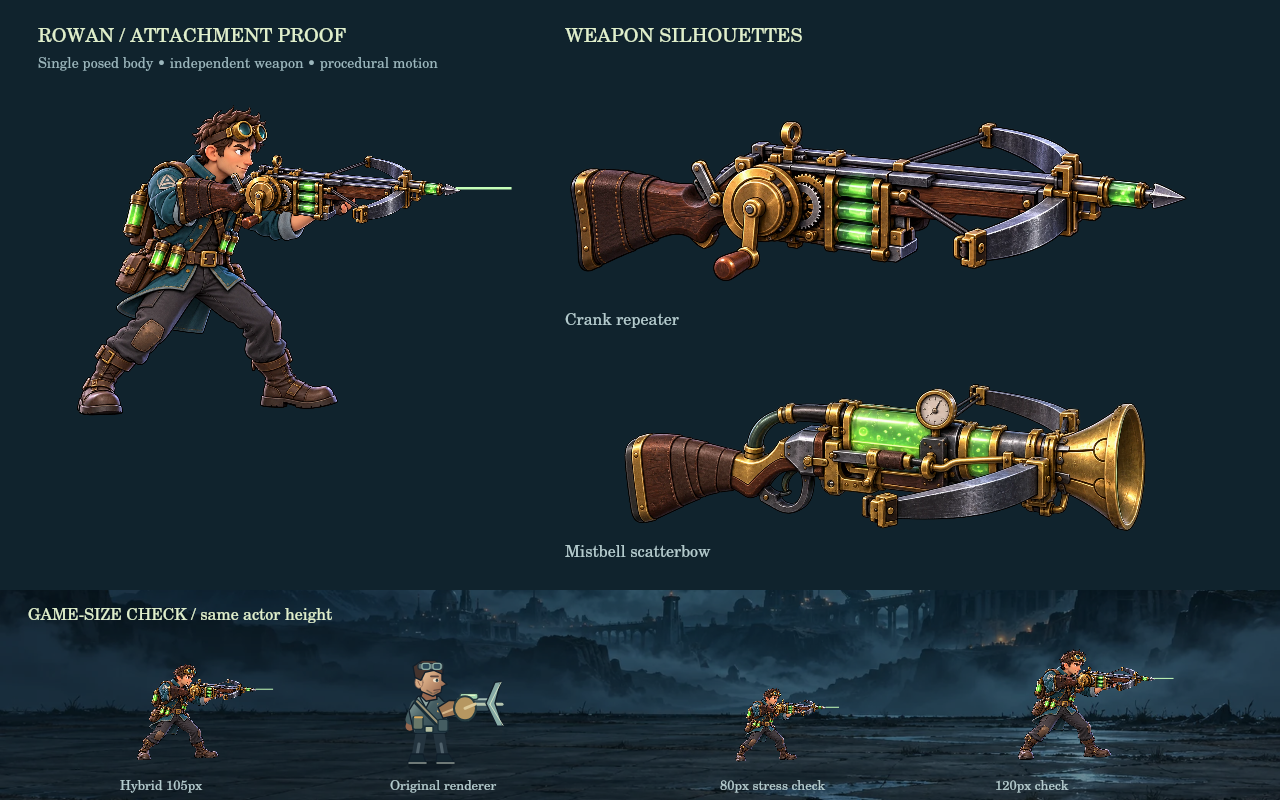
Rowan and the Crank repeater in the Art Lab, alongside the Mistbell design.
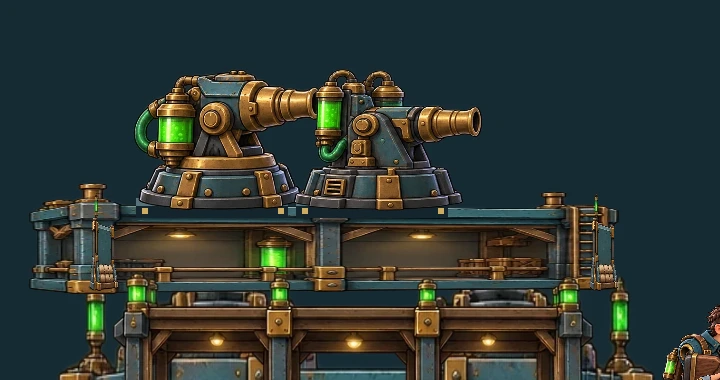
Two illustrated brass-and-green turrets ready to join the laboratory defences.
Images still to add
1111 · Making them walk without breaking everything else
I thought the static characters looked rough. Then we made them walk, and I started appreciating how hard it is for a still picture to put a foot in the wrong place. Animation managed it.
The earliest enemies had motion, but it was largely procedural. A leg endpoint moved back and forth, the torso bobbed, a wing tip rotated. That gave us life at almost no asset cost, yet the movement looked smeared on small screens and could make a body read as one stiff piece. We wanted something closer to four clear advance poses and three attack poses per enemy, with a more believable foot plant, body lean and attack silhouette. A cured civilian's run gave us a useful reference for a repeating cycle.
The later character-sheet work covered the shambler, runner, brute, Shadehound, robots and Last Vector. The goal was consistency: a player should recognise the enemy while it walks, attacks, gets cured or changes boss phase. That meant controlling scale, anchor point, shadow, facing direction and the relationship between limbs and accessories. A weapon drawn on a separate layer cannot drift away from its hand. A shield should stay attached to an arm; a bat's feet should not flatten into the ground every time the walk frame advances.
And those last two happened. I spotted flat bat legs and a boss shield bending on each step and we recorded them as known issues. They weren't magically fixed by writing a nicer Journal article, and they should not be described as resolved until a patched build and test demonstrate it. They belong in this story precisely because they show the difference between asking for walking animations and making them play well inside an existing game.
There were also less obvious visual mistakes. A shadow that floats under a bat is a tiny thing until it's the only clue to where the creature is. A headshot zone placed where the code thinks a face should be, rather than where the new sprite shows one, makes the player distrust aiming. Roof turrets and crew positions had to stay attached when the garrison expanded. Gus's stream needed to start from the correct visual point. Those are all registration problems—the drawn world and the playable world have to line up.
I didn't want us throwing more frames at every enemy and calling that a fix. More frames cost download size, memory and draw time, particularly on older devices. The build retained graphics quality settings and reduced-motion options, and we kept asking for checks on real phones as well as desktop renderers. The character-sheet GIF is useful evidence of an animation study; it isn't evidence that every corresponding frame was integrated perfectly into the released game.
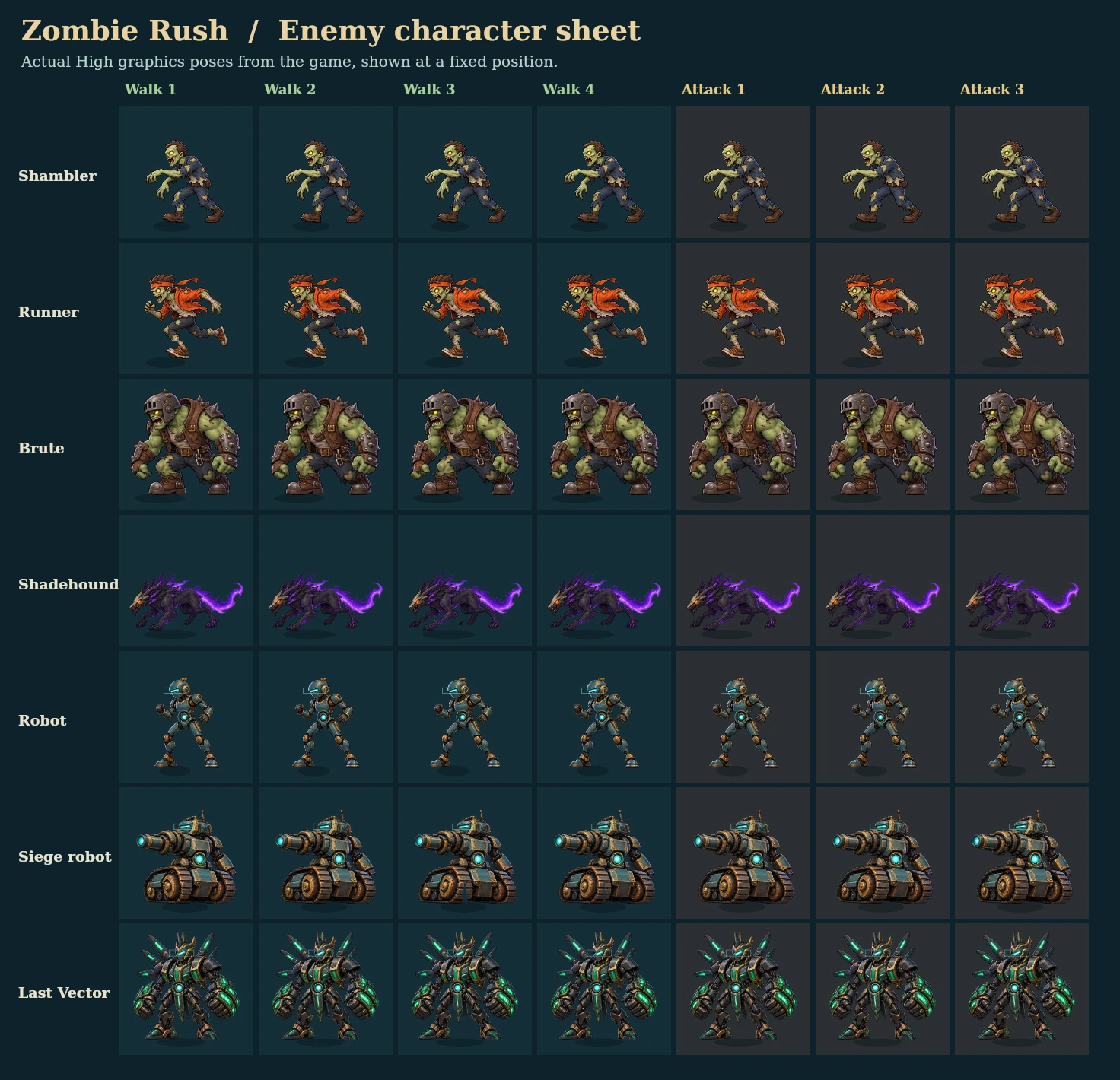
Walk and attack poses for several enemy types in the later animation study; not proof that the released walk issues were fixed.
Images still to add
1212 · The sound of a crossbow should not be the sound of everything
At the beginning I was happy hearing something when the crossbow fired. The browser synthesised short effects for shots, hits and the laboratory, and for the first prototype that was enough. That suited an offline prototype. No audio files had to be downloaded, and the game could start with a sound on the first click. The trouble was that once the arsenal grew, a click was a poor way to tell the Crank repeater from the Gatling, or a reload from a piece of debris hitting the wall.
Nightfall brought sampled foley from Kenney, used under its CC0 licence, alongside our existing effects. Later I asked MakerMouse to rebuild the combat sound layer instead of endlessly stacking generic clicks. The v0.4.3 upgrade produced 42 rendered samples covering different crossbow families, the twinshot, repeater, Gatling, Needle and Mistbell, electric coil, mist hose, reloads, latch, hits, damage, explosions, mortar, purge and the evacuation cure-nuke. The archive describes the weapon sounds as combinations of damped-string behaviour, mechanical hits, filtered air and body resonance; bigger explosions got low impact, pressure tail, detail and short reflections.
I didn't want every trigger pull to sound like the same MP3 being hammered a hundred times. Weapons rotated between three samples; other revised cues had two. The mixer had a cap of 20 simultaneous voices with ordinary effect throttling. A major blast could displace an older, less important sound rather than be silently lost in the queue. The Crank repeater was explicitly given a different voice from the Gatling because they had begun to sound too similar.
We were also checking delivery mechanics, not just sound design. The samples were 44.1 kHz mono MP3s at 96 kbps. A short preview track arranged selected sounds with gaps so we could audition them outside gameplay. One handover even arrived with an empty or unusable audio preview. That was repaired and the actual downloaded file decoded to confirm it wasn't just a filename with nothing useful inside. The complete combat bundle was about 1.16 MB, including retained ambience and other cues—a sensible trade-off against generating audio every time a sound played.
There was still a validation boundary. FFmpeg decoding, mixer tests, mute tests and source parsing establish that files and rules behave as intended. They don't establish how the sounds actually feel through a phone speaker or whether a huge nuke swamps the music. Listening was a human playtest job. We kept it separate from the question of whether the code could load the assets at all.
Images still to add
1313 · Suno, haunted woods and a soundtrack that knows when a boss arrives
A few seconds of eerie ambience worked for the first playable alpha. It did not work terribly well for a long campaign. When you're defending a base for dozens of nights, hearing one tiny loop reset again and again starts to feel like the game is teasing you. I wanted a proper score: spooky without deafening my kids, recognisable from area to area, and noticeably different when a boss or a rush arrived.
The first music workflow wasn't an automatic score engine. The v0.4.2 settings let us select multiple local music files. The game rotated them in selection order by night, repeated a track for the duration of that night, and obeyed mute and ambience volume. The files remained on the device and were not uploaded. It was useful for auditioning music but still depended on the player picking files again after reopening. At that point the source explicitly said the game did not have boss-aware soundtrack routing. That came later.
I used Suno to produce batches of instrumental tracks, then supplied the selected audio to MakerMouse for the game integration. I supplied custom soundtrack packs as the project grew: early haunted-woodland and AEGIS themes, plus a separate boss-themed set and more frightening pieces for intense operations. The production direction was specific: spooky cartoon adventure rather than horror shrieks, enough movement for a fight, no vocals over the sound effects, and a structure that could loop without a jarring stop. Our own audio mixes needed space for firing, reloads, zombie impacts, laboratory alarms and the enormous cure-nuke. A good song by itself isn't automatically a good song underneath combat.
In the public package, the soundtrack was no longer merely a picker. The v0.9.12 Cloudflare Pages build contains a manifest of 29 audio entries divided into five groups: five Outpost, nine AEGIS, six boss, two scary/rush and seven general. The manifest includes source-audio hashes, and three entries duplicate an earlier hash. That makes 26 distinct source-audio hashes, not evidence of 29 entirely different compositions. The audio payload listed in that manifest totals roughly 48.3 MB. The game uses M4A files, a practical choice for browser delivery given the size of a real soundtrack.
This wasn't just a folder of music that MakerMouse shuffled. I wanted the score to react to the kind of night I was playing. The released music director reads the current map/chapter, operation, a boss flag and the campaign's rush-operation metadata. In simplified terms it chooses:
| Situation | Music group | What players hear |
|---|---|---|
| Title screen | Scary | Establishes the spooky mood before play |
| Boss becomes active during the current night | Boss | Boss set, retained for that night once triggered |
| Operation explicitly marked as a rush | Scary | Higher-tension set for the rush |
| Every third normal operation | General | A change of pacing between themed tracks |
| Other AEGIS operations | AEGIS | Industrial/perimeter music for the primary lab |
| Other Outpost operations | Outpost | Haunted woodland theme |
| Custom local music selected | Custom selection | Overrides grouped soundtrack selection while active |
The exact order matters: boss takes precedence over rush, and a flagged rush takes precedence over normal area rotation. The code also rotates within a group rather than restarting the same opening track every eligible night. When the music selection changes it fades the old audio down and brings the new selection up over approximately 1.5 seconds, avoiding an abrupt cut during a fight. The playback controller loops the track, defaults music volume to 30%, and honours the mute/music settings. If a browser blocks autoplay, sound still needs a user interaction before it can play properly.
The soundtrack routing was a game-system change, not simply an MP3 import. The boss flag and rush metadata that we had introduced while designing AEGIS now had to drive the music state; the music state in turn had to coexist with browser autoplay restrictions, mute controls, gunfire and explosions. We were maintaining two audio layers: short responsive effects and a longer-running score.
This integration required two different kinds of testing. We could check that every manifest entry pointed to a real file, the files decoded, the category counts made sense, the group precedence was correct, and a rush or boss switched tracks. Then we still needed to listen: did the soundtrack drown the crossbow? Did the short boss fight end before the music got going? Did a scary track play on the right night? Did any import contain silence, clipping or a file with a misleading name? Those are not things a filename tells you.
One practical lesson I took from all this: The soundtrack's 48 MB is much bigger than the sample-effect pack. That affects website loading and mobile data use. It wasn't free to host just because Suno helped create it. The game assets and soundtrack were packaged for Cloudflare Pages, while the D4Maker site linked or embedded that playable build. We kept the audio source out of the website's unrelated generator workflow.
I supplied the tracks from my paid Suno account, and the game credits record my confirmation of the relevant usage rights. That's how I credited the project; it isn't an independent legal audit of every licence. Kenney's separate CC0 effects have their own acknowledgement.
Images still to add
Mobile, release and what I learnt
1414 · The game worked on my phone. Playing it was another matter.
I'd started out wanting a browser game. By early November we'd crossed into Android packaging, using Capacitor to wrap the web game as an installed APK. Getting an APK to open on a phone was exciting, but it did not prove the controls were good. The build ran, and the graphics settings could be changed, yet the phone had far less room than the big desktop monitor we had been designing around.
Menus that had been tolerable with a mouse were suddenly enormous. The previous/next controls were far away from the items they navigated. Ammo and lab purchases didn't fit comfortably; some labels and buttons overlapped or forced scrolling. Aiming with a finger put my hand over the very enemy I needed to see. We had to rethink the input layout rather than shrink the desktop UI until it resembled a postage stamp.
The changes included smaller menu controls and clearer paging, with ammo and research grouped into manageable sets; a drag-to-aim approach; an optional floating aim joystick; a moveable Fire button; and opacity/layout options that let the controls get out of the way. Touch inputs also needed to behave correctly when the player dragged, tapped Fire, paused, changed focus, or came back from the Android system UI. A lost pointer-up event must not leave the game firing forever.
One of my most useful phone comparisons was brutal: with the earlier controls I was struggling around nights three or four; after the drag-stick changes I reached night 19. That's my playtest observation, not a controlled benchmark or a promise for every phone. It told us the difficulty was partly in the interface, not only in the wave table.
The app also needed to resume correctly. The game already had checkpoint saves and an export/import path. The Android wrapper was expected to persist the same progress through normal app restarts, and we tested actual installations and updates instead of assuming that an HTML game behaves identically when packaged. Family Link complicated installing a side-loaded APK on a child's device, which is an Android device-management problem rather than a gameplay bug.
Browser play reintroduced a different fullscreen problem after publication. Inside the D4Maker website the game was framed in an iframe, and a mobile fullscreen button added to the wrapper initially kept a permanent Exit bar above it. That reserved valuable height and made the game letterbox. We fixed the wrapper so the game iframe itself entered fullscreen. This is a nice example of the difference between a game that can run fullscreen and a website that actually gives it the whole screen.
The Samsung screenshots I've kept from that problem show exactly what was happening: in Mobile layout, the website's Exit full screen bar stole height and the battlefield grew sidebars. Selecting Desktop layout was my temporary way around it. Those are genuine screenshots of the original problem and workaround, not proof of a post-fix test. A matching capture after PR #150 is still on my list.
We deliberately did not treat an APK rebuild as the fix for a website wrapper issue. The mobile app already played natively fullscreen. Website, standalone Cloudflare tab and APK are three related experiences, but not the same container. The game save behaviour and website iframe storage also needed checking separately. When I confirmed that my existing save had carried across into the browser player, we recorded the result rather than inventing a new server-based save system.
Images still to add
1515 · Testing the thing we were actually going to hand over
One habit I won't give up after this build is keeping checkpoints. Every time a playable version changed, we needed to know which source it came from, what was deliberately unchanged and what save would survive the next update. We had alpha ZIPs, small patches, browser packages, art studies, Android builds and saved checkpoints. Not every archive was a new game; some were just fixes to one problem. But those small packages are the paper trail of how the game actually changed.
We tested at several levels. The engine could be run without opening a browser to check damage, wave completion, money, retries, save migration, research XP, anti-farming rules and ending boundaries. Native Canvas render fixtures could check that an asset drew at all and that specific aim positions matched expected geometry. Browser checks looked for real menu flow, readable controls, screenshots, input and storage. Then my phone sessions exposed things the desktop tests could not: thumb obstruction, tiny targets, controls too close to the edges, unwanted scrolling and a game that technically worked but felt unfair to aim.
Keeping those types of evidence separate mattered. The first alpha's 13 engine tests did not establish that a child could beat the game. A campaign simulator that survives all sixty operations with ideal shots doesn't mean Classic is easy enough—or hard enough—for a human. Conversely, a family playtest that makes it to night 19 doesn't prove every save migration and retry path is safe. We needed both.
Some failures were peculiar to packaging. One audio preview had to be rebuilt because the delivered file wasn't usable. A local ZIP could contain the correct web app and still need verification that it opens without missing network assets. Android needed the SDK/JDK setup, the project wrapper, appropriate icons, an installable APK and a real tap-through. Cloudflare Pages needed an actual upload, and the D4Maker website needed a route back from the game so visitors weren't stranded on a separate development address.
We also had to mind the cost and scope of verification. The D4Maker site has GitHub Actions and storage limits; rebuilding unrelated generators every time we changed a game story or link was a waste. The release process was narrowed to the affected game/website paths, with separate approvals for generator runs. The game source lives apart from the website wrapper; that separation helped avoid turning a tiny fullscreen CSS fix into a fresh Android package and a complete website build.
What went public on 8 November was a Cloudflare Pages browser game linked from D4Maker. The site then promoted Zombie Rush as its featured game and added the windowed player and Journal article. The expanded development story followed as a separate website change. The later fullscreen repairs were website PRs, not evidence that we had rebuilt the campaign. That timeline belongs at the end of this article because the game wasn't finished once the last boss died. I still wanted someone visiting D4Maker to find the game, play it, get back to the site and resume their save.
The archived catalogue includes dated ZIPs, two Android APKs, JSON saves, art previews and screenshots. It's a far more useful record than an estimated number of hours. Some builds were code changes; others were testing, artwork, failed revisions or packaging. The accumulated decisions are what made the finished game possible.
Images still to add
1616 · How much AI work did this take? More than twenty prompts.
The original website article suggested a hypothetical 160,000 text tokens: twenty development passes at 6,000 input and 2,000 output tokens each. The multiplication was fine. The implication was not. Zombie Rush wasn't twenty neat passes with a finished product at the end. We kept coming back with screenshots, balance findings, new art directions, revised enemy behaviour, music imports, save exports and broken builds. Some passes were tiny, some involved full source changes and another round of validation. One missed visual alignment could send us back through code, render and testing several times.
I directed the project, with MakerMouse assisting, and I estimate that roughly 95% of our development sessions were in Work mode. That's my recollection, not an exported usage statistic. That distinction is worth explaining. In a normal chat I can ask for code, make decisions and manually use the result. In Work mode, the assistant can carry out larger sequences within an authorised workspace: inspect files, edit source, run relevant tools and tests, package builds and sometimes work with connected services. One request can trigger numerous internal steps and tool interactions, each with its own context and outputs. That's why counting only my visible messages would still underestimate the amount of model processing and tool work involved. It also doesn't make the code or the design autonomous: I was deciding what to build, playing it, giving blunt feedback, and approving changes.
A message count is not the same thing as a tool-call count, a development pass or a token total. In Work mode I might send one instruction and MakerMouse would inspect several files, update code, run focused checks and return a build. Another time I would send a string of short, specific observations after playing a single night. I don't want to turn either case into a made-up 'one prompt equals one unit of effort' formula.
We have more solid evidence for deliverables than for total model consumption. The development handover catalogue preserves 39 dated records spanning 29 October to 8 November 2026. Among them are many ZIP checkpoints, Android APKs, saves, visual studies and late browser updates. It documents a first playable alpha, expansions from five to ten nights, successive AEGIS acts, sound production, hybrid-art tests and web publication. It does not document every question and answer, every internal agent step or every token spent. One archive could contain several requests' work; one request could also create more than one archive.
The true project token total cannot be calculated from the files presently available. To publish a defensible prompt/response count we'd need complete, exportable conversation transcripts covering all relevant threads and Work runs, a repeatable rule for what counts as a 'prompt' and 'response', and a way to separate human-visible messages from tool calls and background reasoning. For a token number we'd also need actual usage metadata by model/tool run, including repeated context, not merely the words in the transcript. Where those records aren't available, guessing 'five million' or 'twenty million' and printing it as fact would be no improvement over the 160k claim.
The statement I'm comfortable putting my name to is this: we used AI-assisted development iteratively across many files, checkpoints and playtests, and I did most of that work through Work mode. Several million text tokens is plausible for a project with repeated large-context passes; it is not a measured project total. Image generation, Suno music, browser QA, native artwork, Android builds and Cloudflare hosting are different types of resource use and should not be silently added to a text-token estimate as though they're all the same unit.
I'd rather publish the actual work—the files, the revisions, the mistakes and the playtests—than a clever-looking invented invoice for an AI that didn't keep receipts.
Images still to add
1717 · What's still on the bench
The game is playable. That's worth saying plainly. People can load it in a browser or install the Android APK, and the sixty-night campaign exists. My family has played it, found weak spots and helped push it much further than I expected when I gave MakerMouse the first brief.
It's also fair to say it isn't perfect. The animation bug list still includes flat bat legs and a boss shield that bends when the character walks. Some hybrid artwork and precision-target registration need more careful checking. The UI works substantially better on a phone, but small-screen menus and the difference between website iframe, standalone browser and installed APK are things we now know to validate separately. The soundtrack classes work in code; the mix is still a judgement call that deserves listening on real speakers.
I wouldn't take back the rough first Canvas zombies. They made the idea playable almost immediately. I also wouldn't skip the frustrating middle: ten AEGIS operations at a time, building and replaying the explosions, changing prices when I had too much money, tightening the crew XP curve, and finding out that better artwork could make aim feel worse. Those are the parts that made Zombie Rush our own game instead of a skin over somebody else's.
The next build can improve the bat, the shield and the remaining rough edges. This article should preserve where we were when we published, not quietly repaint the history after the next patch.
Credits: I designed and directed Zombie Rush as D4Maker , making the gameplay calls and doing hands-on testing. MakerMouse assisted with implementation, debugging, testing and packaging. My family helped playtest the game. I created and selected music using Suno and supplied the tracks from my paid account. Sound effects: original produced samples plus Kenney's CC0 assets where used. Android runtime: Capacitor . Fonts include Creepster and Atkinson Hyperlegible , with licences in the game package. The gameplay inspiration was Storm the House 2 by IvoryDrive. Zombie Rush uses its own code and project artwork; this is not an official sequel or affiliation.